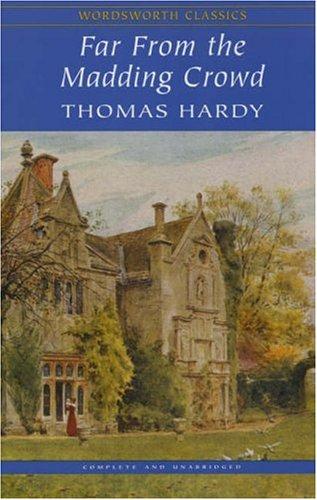
Public domain. Not under copyright: Hardy, Thomas (d. 1928). Everyone credited died more than 50 years ago, outside Pakistan's life-plus-50 term, and Project Gutenberg lists the text as public domain. Newer translations or editions can carry separate rights. Source: Project Gutenberg
HIVING THE BEES
The Weatherbury bees were late in their swarming this year. It was in the latter part of June, and the day after the interview with Troy in the hayfield, that Bathsheba was standing in her garden, watching a swarm in the air and guessing their probable settling place. Not only were they late this year, but unruly. Sometimes throughout a whole season all the swarms would alight on the lowest attainable bough—such as part of a currant-bush or espalier apple-tree; next year they would, with just the same unanimity, make straight off to the uppermost member of some tall, gaunt costard, or quarrington, and there defy all invaders who did not come armed with ladders and staves to take them.
This was the case at present. Bathsheba’s eyes, shaded by one hand, were following the ascending multitude against the unexplorable stretch of blue till they ultimately halted by one of the unwieldy trees spoken of. A process was observable somewhat analogous to that of alleged formations of the universe, time and times ago. The bustling swarm had swept the sky in a scattered and uniform haze, which now thickened to a nebulous centre: this glided on to a bough and grew still denser, till it formed a solid black spot upon the light.
The men and women being all busily engaged in saving the hay—even Liddy had left the house for the purpose of lending a hand—Bathsheba resolved to hive the bees herself, if possible. She had dressed the hive with herbs and honey, fetched a ladder, brush, and crook, made herself impregnable with armour of leather gloves, straw hat and large gauze veil—once green but now faded to snuff colour—and ascended a dozen rungs of the ladder. At once she heard, not ten yards off, a voice that was beginning to have a strange power in agitating her.
“Miss Everdene, let me assist you; you should not attempt such a thing alone.”
Troy was just opening the garden gate.
Bathsheba flung down the brush, crook and empty hive, pulled the skirt of her dress tightly round her ankles in a tremendous flurry, and as well as she could slid down the ladder. By the time she reached the bottom Troy was there also, and he stooped to pick up the hive.
“How fortunate I am to have dropped in at this moment!” exclaimed the sergeant.
She found her voice in a minute. “What! and will you shake them in for me?” she asked, in what, for a defiant girl, was a faltering way; though, for a timid girl, it would have seemed a brave way enough.
“Will I!” said Troy. “Why, of course I will. How blooming you are to-day!” Troy flung down his cane and put his foot on the ladder to ascend.
“But you must have on the veil and gloves, or you’ll be stung fearfully!”
“Ah, yes. I must put on the veil and gloves. Will you kindly show me how to fix them properly?”
“And you must have the broad-brimmed hat, too; for your cap has no brim to keep the veil off, and they’d reach your face.”
“The broad-brimmed hat, too, by all means.”
So a whimsical fate ordered that her hat should be taken off—veil and all attached—and placed upon his head, Troy tossing his own into a gooseberry bush. Then the veil had to be tied at its lower edge round his collar and the gloves put on him.
He looked such an extraordinary object in this guise that, flurried as she was, she could not avoid laughing outright. It was the removal of yet another stake from the palisade of cold manners which had kept him off.
Bathsheba looked on from the ground whilst he was busy sweeping and shaking the bees from the tree, holding up the hive with the other hand for them to fall into. She made use of an unobserved minute whilst his attention was absorbed in the operation to arrange her plumes a little. He came down holding the hive at arm’s length, behind which trailed a cloud of bees.
“Upon my life,” said Troy, through the veil, “holding up this hive makes one’s arm ache worse than a week of sword-exercise.” When the manœuvre was complete he approached her. “Would you be good enough to untie me and let me out? I am nearly stifled inside this silk cage.”
To hide her embarrassment during the unwonted process of untying the string about his neck, she said:—
“I have never seen that you spoke of.”
“What?”
“The sword-exercise.”
“Ah! would you like to?” said Troy.
Bathsheba hesitated. She had heard wondrous reports from time to time by dwellers in Weatherbury, who had by chance sojourned awhile in Casterbridge, near the barracks, of this strange and glorious performance, the sword-exercise. Men and boys who had peeped through chinks or over walls into the barrack-yard returned with accounts of its being the most flashing affair conceivable; accoutrements and weapons glistening like stars—here, there, around—yet all by rule and compass. So she said mildly what she felt strongly.
“Yes; I should like to see it very much.”
“And so you shall; you shall see me go through it.”
“No! How?”
“Let me consider.”
“Not with a walking-stick—I don’t care to see that. It must be a real sword.”
“Yes, I know; and I have no sword here; but I think I could get one by the evening. Now, will you do this?”
Troy bent over her and murmured some suggestion in a low voice.
“Oh no, indeed!” said Bathsheba, blushing.” Thank you very much, but I couldn’t on any account.
“Surely you might? Nobody would know.”
She shook her head, but with a weakened negation. “If I were to,” she said, “I must bring Liddy too. Might I not?”
Troy looked far away. “I don’t see why you want to bring her,” he said coldly.
An unconscious look of assent in Bathsheba’s eyes betrayed that something more than his coldness had made her also feel that Liddy would be superfluous in the suggested scene. She had felt it, even whilst making the proposal.
“Well, I won’t bring Liddy—and I’ll come. But only for a very short time,” she added; “a very short time.”
“It will not take five minutes,” said Troy.
A FOGGY NIGHT AND MORNING—CONCLUSION
“The most private, secret, plainest wedding that it is possible to have.”
Those had been Bathsheba’s words to Oak one evening, some time after the event of the preceding chapter, and he meditated a full hour by the clock upon how to carry out her wishes to the letter.
“A licence—Oh yes, it must be a licence,” he said to himself at last. “Very well, then; first, a licence.”
On a dark night, a few days later, Oak came with mysterious steps from the surrogate’s door, in Casterbridge. On the way home he heard a heavy tread in front of him, and, overtaking the man, found him to be Coggan. They walked together into the village until they came to a little lane behind the church, leading down to the cottage of Laban Tall, who had lately been installed as clerk of the parish, and was yet in mortal terror at church on Sundays when he heard his lone voice among certain hard words of the Psalms, whither no man ventured to follow him.
“Well, good night, Coggan,” said Oak, “I’m going down this way.”
“Oh!” said Coggan, surprised; “what’s going on to-night then, make so bold, Mr. Oak?”
It seemed rather ungenerous not to tell Coggan, under the circumstances, for Coggan had been true as steel all through the time of Gabriel’s unhappiness about Bathsheba, and Gabriel said, “You can keep a secret, Coggan?”
“You’ve proved me, and you know.”
“Yes, I have, and I do know. Well, then, mistress and I mean to get married to-morrow morning.”
“Heaven’s high tower! And yet I’ve thought of such a thing from time to time; true, I have. But keeping it so close! Well, there, ’tis no consarn of mine, and I wish ye joy o’ her.”
“Thank you, Coggan. But I assure ye that this great hush is not what I wished for at all, or what either of us would have wished if it hadn’t been for certain things that would make a gay wedding seem hardly the thing. Bathsheba has a great wish that all the parish shall not be in church, looking at her—she’s sky-like and nervous about it, in fact—so I be doing this to humour her.”
“Ay, I see: quite right, too, I suppose I must say. And you be now going down to the clerk.”
“Yes; you may as well come with me.”
“I am afeard your labour in keeping it close will be throwed away,” said Coggan, as they walked along. “Labe Tall’s old woman will horn it all over parish in half an hour.”
“So she will, upon my life; I never thought of that,” said Oak, pausing. “Yet I must tell him to-night, I suppose, for he’s working so far off, and leaves early.”
“I’ll tell ye how we could tackle her,” said Coggan. “I’ll knock and ask to speak to Laban outside the door, you standing in the background. Then he’ll come out, and you can tell yer tale. She’ll never guess what I want en for; and I’ll make up a few words about the farm-work, as a blind.”
This scheme was considered feasible; and Coggan advanced boldly, and rapped at Mrs. Tall’s door. Mrs. Tall herself opened it.
“I wanted to have a word with Laban.”
“He’s not at home, and won’t be this side of eleven o’clock. He’ve been forced to go over to Yalbury since shutting out work. I shall do quite as well.”
“I hardly think you will. Stop a moment.” And Coggan stepped round the corner of the porch to consult Oak.
“Who’s t’other man, then?” said Mrs. Tall.
“Only a friend,” said Coggan.
“Say he’s wanted to meet mistress near church-hatch to-morrow morning at ten,” said Oak, in a whisper. “That he must come without fail, and wear his best clothes.”
“The clothes will floor us as safe as houses!” said Coggan.
“It can’t be helped,” said Oak. “Tell her.”
So Coggan delivered the message. “Mind, het or wet, blow or snow, he must come,” added Jan. “’Tis very particular, indeed. The fact is ’tis to witness her sign some law-work about taking shares wi’ another farmer for a long span o’ years. There, that’s what ’tis, and now I’ve told ye, Mother Tall, in a way I shouldn’t ha’ done if I hadn’t loved ye so hopeless well.”
Coggan retired before she could ask any further; and next they called at the vicar’s in a way which excited no curiosity at all. Then Gabriel went home, and prepared for the morrow.
“Liddy,” said Bathsheba, on going to bed that night, “I want you to call me at seven o’clock to-morrow, in case I shouldn’t wake.”
“But you always do wake afore then, ma’am.”
“Yes, but I have something important to do, which I’ll tell you of when the time comes, and it’s best to make sure.”
Bathsheba, however, awoke voluntarily at four, nor could she by any contrivance get to sleep again. About six, being quite positive that her watch had stopped during the night, she could wait no longer. She went and tapped at Liddy’s door, and after some labour awoke her.
“But I thought it was I who had to call you?” said the bewildered Liddy. “And it isn’t six yet.”
Indeed it is; how can you tell such a story, Liddy? I know it must be ever so much past seven. Come to my room as soon as you can; I want you to give my hair a good brushing.”
When Liddy came to Bathsheba’s room her mistress was already waiting. Liddy could not understand this extraordinary promptness. “Whatever _is_ going on, ma’am?” she said.
“Well, I’ll tell you,” said Bathsheba, with a mischievous smile in her bright eyes. “Farmer Oak is coming here to dine with me to-day!”
“Farmer Oak—and nobody else?—you two alone?”
“Yes.”
“But is it safe, ma’am?” said her companion, dubiously. “A woman’s good name is such a perishable article that——”
Bathsheba laughed with a flushed cheek, and whispered in Liddy’s ear, although there was nobody present. Then Liddy stared and exclaimed, “Souls alive, what news! It makes my heart go quite bumpity-bump!”
“It makes mine rather furious, too,” said Bathsheba. “However, there’s no getting out of it now.”
It was a damp disagreeable morning. Nevertheless, at twenty minutes to ten o’clock, Oak came out of his house, and
“Went up the hill side With that sort of stride A man puts out when walking in search of a bride,”
and knocked Bathsheba’s door. Ten minutes later two large umbrellas might have been seen moving from the same door, and through the mist along the road to the church. The distance was not more than a hundred yards, and these two sensible persons deemed it unnecessary to drive. An observer must have been very close indeed to discover that the forms under the umbrellas were those of Oak and Bathsheba, arm-in-arm for the first time in their lives, Oak in a great coat extending to his knees, and Bathsheba in a cloak that reached her clogs. Yet, though so plainly dressed, there was a certain rejuvenated appearance about her:—
“As though a rose should shut and be a bud again.”
Repose had again incarnadined her cheeks; and having, at Gabriel’s request, arranged her hair this morning as she had worn it years ago on Norcombe Hill, she seemed in his eyes remarkably like the girl of that fascinating dream, which, considering that she was now only three or four-and-twenty, was perhaps not very wonderful. In the church were Tall, Liddy, and the parson, and in a remarkably short space of time the deed was done.
The two sat down very quietly to tea in Bathsheba’s parlour in the evening of the same day, for it had been arranged that Farmer Oak should go there to live, since he had as yet neither money, house, nor furniture worthy of the name, though he was on a sure way towards them, whilst Bathsheba was, comparatively, in a plethora of all three.
Just as Bathsheba was pouring out a cup of tea, their ears were greeted by the firing of a cannon, followed by what seemed like a tremendous blowing of trumpets, in the front of the house.
“There!” said Oak, laughing, “I knew those fellows were up to something, by the look on their faces.”
Oak took up the light and went into the porch, followed by Bathsheba with a shawl over her head. The rays fell upon a group of male figures gathered upon the gravel in front, who, when they saw the newly-married couple in the porch, set up a loud “Hurrah!” and at the same moment bang again went the cannon in the background, followed by a hideous clang of music from a drum, tambourine, clarionet, serpent, hautboy, tenor-viol, and double-bass—the only remaining relics of the true and original Weatherbury band—venerable worm-eaten instruments, which had celebrated in their own persons the victories of Marlhorough, under the fingers of the forefathers of those who played them now. The performers came forward, and marched up to the front.
“Those bright boys, Mark Clark and Jan are at the bottom of all this,” said Oak. “Come in, souls, and have something to eat and drink wi’ me and my wife.”
“Not to-night,” said Mr. Clark, with evident self-denial. “Thank ye all the same; but we’ll call at a more seemly time. However, we couldn’t think of letting the day pass without a note of admiration of some sort. If ye could send a drop of som’at down to Warren’s, why so it is. Here’s long life and happiness to neighbour Oak and his comely bride!”
“Thank ye; thank ye all,” said Gabriel. “A bit and a drop shall be sent to Warren’s for ye at once. I had a thought that we might very likely get a salute of some sort from our old friends, and I was saying so to my wife but now.”
“Faith,” said Coggan, in a critical tone, turning to his companions, “the man hev learnt to say ‘my wife’ in a wonderful naterel way, considering how very youthful he is in wedlock as yet—hey, neighbours all?”
“I never heerd a skilful old married feller of twenty years’ standing pipe ‘my wife’ in a more used note than ’a did,” said Jacob Smallbury. “It might have been a little more true to nater if ’t had been spoke a little chillier, but that wasn’t to be expected just now.”
“That improvement will come with time,” said Jan, twirling his eye.
Then Oak laughed, and Bathsheba smiled (for she never laughed readily now), and their friends turned to go.
“Yes; I suppose that’s the size o’t,” said Joseph Poorgrass with a cheerful sigh as they moved away; “and I wish him joy o’ her; though I were once or twice upon saying to-day with holy Hosea, in my scripture manner, which is my second nature. ‘Ephraim is joined to idols: let him alone.’ But since ’tis as ’tis why, it might have been worse, and I feel my thanks accordingly.”
THE END
Be the first to comment.