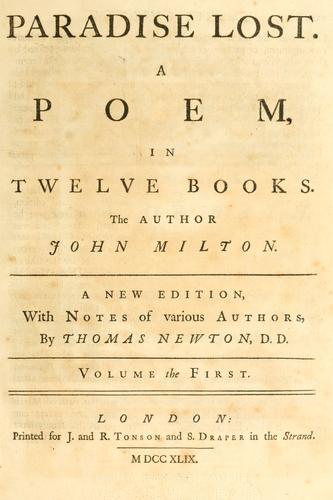
Public domain. Not under copyright: Milton, John (d. 1674). Everyone credited died more than 50 years ago, outside Pakistan's life-plus-50 term, and Project Gutenberg lists the text as public domain. Newer translations or editions can carry separate rights. Source: Project Gutenberg
He lookd and saw a spacious Plaine, whereon
Were Tents of various hue; by some were herds
Of Cattel grazing: others, whence the sound
Of Instruments that made melodious chime
Was heard, of Harp and Organ; and who moovd
Thir stops and chords was seen: his volant touch
Instinct through all proportions low and high
Fled and pursu’d transverse the resonant fugue.
In other part stood one who at the Forge
Labouring, two massie clods of Iron and Brass
Had melted (whether found where casual fire
Had wasted woods on Mountain or in Vale,
Down to the veins of Earth, thence gliding hot
To som Caves mouth, or whether washt by stream
From underground) the liquid Ore he dreind
Into fit moulds prepar’d; from which he formd
First his own Tooles; then, what might else be wrought
Fusil or grav’n in mettle. After these,
But on the hether side a different sort
From the high neighbouring Hills, which was thir Seat,
Down to the Plain descended: by thir guise
Just men they seemd, and all thir study bent
To worship God aright, and know his works
Not hid, nor those things lost which might preserve
Freedom and Peace to men: they on the Plain
Long had not walkt, when from the Tents behold
A Beavie of fair Women, richly gay
In Gems and wanton dress; to the Harp they sung
Soft amorous Ditties, and in dance came on:
The Men though grave, ey’d them, and let thir eyes
Rove without rein, till in the amorous Net
Fast caught, they lik’d, and each his liking chose;
And now of love they treat till th’ Eevning Star
Loves Harbinger appeerd; then all in heat
They light the Nuptial Torch, and bid invoke
Hymen, then first to marriage Rites invok’t;
With Feast and Musick all the Tents resound.
Such happy interview and fair event
Of love & youth not lost, Songs, Garlands, Flours,
And charming Symphonies attach’d the heart
Of _Adam_, soon enclin’d to admit delight,
The bent of Nature; which he thus express’d.
True opener of mine eyes, prime Angel blest,
Much better seems this Vision, and more hope
Of peaceful dayes portends, then those two past;
Those were of hate and death, or pain much worse,
Here Nature seems fulfilld in all her ends.
To whom thus _Michael_. Judg not what is best
By pleasure, though to Nature seeming meet,
Created, as thou art, to nobler end
Holie and pure, conformitie divine.
Those Tents thou sawst so pleasant, were the Tents
Of wickedness, wherein shall dwell his Race
Who slew his Brother; studious they appere
Of Arts that polish Life, Inventers rare,
Unmindful of thir Maker, though his Spirit
Taught them, but they his gifts acknowledg’d none.
Yet they a beauteous ofspring shall beget;
For that fair femal Troop thou sawst, that seemd
Of Goddesses, so blithe, so smooth, so gay,
Yet empty of all good wherein consists
Womans domestic honour and chief praise;
Bred onely and completed to the taste
Of lustful appetence, to sing, to dance,
To dress, and troule the Tongue, and roule the Eye.
To these that sober Race of Men, whose lives
Religious titl’d them the Sons of God,
Shall yeild up all thir vertue, all thir fame
Ignobly, to the traines and to the smiles
Of these fair Atheists, and now swim in joy,
(Erelong to swim at larg) and laugh; for which
The world erelong a world of tears must weepe.
To whom thus _Adam_ of short joy bereft.
O pittie and shame, that they who to live well
Enterd so faire, should turn aside to tread
Paths indirect, or in the mid way faint!
But still I see the tenor of Mans woe
Holds on the same, from Woman to begin.
From Mans effeminate slackness it begins,
Said th’ Angel, who should better hold his place
By wisdome, and superiour gifts receavd.
But now prepare thee for another Scene.
He lookd and saw wide Territorie spred
Before him, Towns, and rural works between,
Cities of Men with lofty Gates and Towrs,
Concours in Arms, fierce Faces threatning Warr,
Giants of mightie Bone, and bould emprise;
Part wield thir Arms, part courb the foaming Steed,
Single or in Array of Battel rang’d
Both Horse and Foot, nor idely mustring stood;
One way a Band select from forage drives
A herd of Beeves, faire Oxen and faire Kine
From a fat Meddow ground; or fleecy Flock,
Ewes and thir bleating Lambs over the Plaine,
Thir Bootie; scarce with Life the Shepherds flye,
But call in aide, which tacks a bloody Fray;
With cruel Tournament the Squadrons joine;
Where Cattel pastur’d late, now scatterd lies
With Carcasses and Arms th’ ensanguind Field
Deserted: Others to a Citie strong
Lay Siege, encampt; by Batterie, Scale, and Mine,
Assaulting; others from the Wall defend
With Dart and Jav’lin, Stones and sulfurous Fire;
On each hand slaughter and gigantic deeds.
In other part the scepter’d Haralds call
To Council in the Citie Gates: anon
Grey-headed men and grave, with Warriours mixt,
Assemble, and Harangues are heard, but soon
In factious opposition, till at last
Of middle Age one rising, eminent
In wise deport, spake much of Right and Wrong,
Of Justice, of Religion, Truth and Peace,
And Judgement from above: him old and young
Exploded, and had seiz’d with violent hands,
Had not a Cloud descending snatch’d him thence
Unseen amid the throng: so violence
Proceeded, and Oppression, and Sword-Law
Through all the Plain, and refuge none was found.
_Adam_ was all in tears, and to his guide
Lamenting turnd full sad; O what are these,
Deaths Ministers, not Men, who thus deal Death
Inhumanly to men, and multiply
Ten thousand fould the sin of him who slew
His Brother; for of whom such massacher
Make they but of thir Brethren, men of men?
But who was that Just Man, whom had not Heav’n
Rescu’d, had in his Righteousness bin lost?
To whom thus _Michael_; These are the product
Of those ill-mated Marriages thou saw’st;
Where good with bad were matcht, who of themselves
Abhor to joyn; and by imprudence mixt,
Produce prodigious Births of bodie or mind.
Such were these Giants, men of high renown;
For in those dayes Might onely shall be admir’d,
And Valour and Heroic Vertu call’d;
To overcome in Battel, and subdue
Nations, and bring home spoils with infinite
Man-slaughter, shall be held the highest pitch
Of human Glorie, and for Glorie done
Of triumph, to be styl’d great Conquerours,
Patrons of Mankind, Gods, and Sons of Gods,
Destroyers rightlier call’d and Plagues of men.
Thus Fame shall be achiev’d, renown on Earth,
And what most merits fame in silence hid.
But hee the seventh from thee, whom thou beheldst
The onely righteous in a World perverse,
And therefore hated, therefore so beset
With Foes for daring single to be just,
And utter odious Truth, that God would come
To judge them with his Saints: Him the most High
Rapt in a balmie Cloud with winged Steeds
Did, as thou sawst, receave, to walk with God
High in Salvation and the Climes of bliss,
Exempt from Death; to shew thee what reward
Awaits the good, the rest what punishment;
Which now direct thine eyes and soon behold.
He look’d, & saw the face of things quite chang’d;
The brazen Throat of Warr had ceast to roar,
All now was turn’d to jollitie and game,
To luxurie and riot, feast and dance,
Marrying or prostituting, as befell,
Rape or Adulterie, where passing faire
Allurd them; thence from Cups to civil Broiles.
At length a Reverend Sire among them came,
And of thir doings great dislike declar’d,
And testifi’d against thir wayes; hee oft
Frequented thir Assemblies, whereso met,
Triumphs or Festivals, and to them preachd
Conversion and Repentance, as to Souls
In prison under Judgements imminent:
But all in vain: which when he saw, he ceas’d
Contending, and remov’d his Tents farr off;
Then from the Mountain hewing Timber tall,
Began to build a Vessel of huge bulk,
Measur’d by Cubit, length, & breadth, and highth,
Smeard round with Pitch, and in the side a dore
Contriv’d, and of provisions laid in large
For Man and Beast: when loe a wonder strange!
Of everie Beast, and Bird, and Insect small
Came seavens, and pairs, and enterd in, as taught
Thir order; last the Sire, and his three Sons
With thir four Wives; and God made fast the dore.
Meanwhile the Southwind rose, & with black wings
Wide hovering, all the Clouds together drove
From under Heav’n; the Hills to their supplie
Vapour, and Exhalation dusk and moist,
Sent up amain; and now the thick’nd Skie
Like a dark Ceeling stood; down rush’d the Rain
Impetuous, and continu’d till the Earth
No more was seen; the floating Vessel swum
Uplifted; and secure with beaked prow
Rode tilting o’re the Waves, all dwellings else
Flood overwhelmd, and them with all thir pomp
Deep under water rould; Sea cover’d Sea,
Sea without shoar; and in thir Palaces
Where luxurie late reign’d, Sea-monsters whelp’d
And stabl’d; of Mankind, so numerous late,
All left, in one small bottom swum imbark’t.
How didst thou grieve then, _Adam_, to behold
The end of all thy Ofspring, end so sad,
Depopulation; thee another Floud,
Of tears and sorrow a Floud thee also drown’d,
And sunk thee as thy Sons; till gently reard
By th’ Angel, on thy feet thou stoodst at last,
Though comfortless, as when a Father mourns
His Childern, all in view destroyd at once;
And scarce to th’ Angel utterdst thus thy plaint.
Be the first to comment.