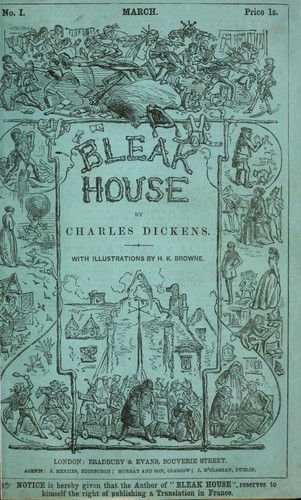
Public domain. Not under copyright: Dickens, Charles (d. 1870). Everyone credited died more than 50 years ago, outside Pakistan's life-plus-50 term, and Project Gutenberg lists the text as public domain. Newer translations or editions can carry separate rights. Source: Project Gutenberg
Still Guster reiterates “one thousing seven hundred and eighty-two.”
Mr. Chadband, pausing with the resignation of a man accustomed to be persecuted and languidly folding up his chin into his fat smile, says, “Let us hear the maiden! Speak, maiden!”
“One thousing seven hundred and eighty-two, if you please, sir. Which he wish to know what the shilling ware for,” says Guster, breathless.
“For?” returns Mrs. Chadband. “For his fare!”
Guster replied that “he insistes on one and eightpence or on summonsizzing the party.” Mrs. Snagsby and Mrs. Chadband are proceeding to grow shrill in indignation when Mr. Chadband quiets the tumult by lifting up his hand.
“My friends,” says he, “I remember a duty unfulfilled yesterday. It is right that I should be chastened in some penalty. I ought not to murmur. Rachael, pay the eightpence!”
While Mrs. Snagsby, drawing her breath, looks hard at Mr. Snagsby, as who should say, “You hear this apostle!” and while Mr. Chadband glows with humility and train oil, Mrs. Chadband pays the money. It is Mr. Chadband’s habit—it is the head and front of his pretensions indeed—to keep this sort of debtor and creditor account in the smallest items and to post it publicly on the most trivial occasions.
“My friends,” says Chadband, “eightpence is not much; it might justly have been one and fourpence; it might justly have been half a crown. O let us be joyful, joyful! O let us be joyful!”
With which remark, which appears from its sound to be an extract in verse, Mr. Chadband stalks to the table, and before taking a chair, lifts up his admonitory hand.
“My friends,” says he, “what is this which we now behold as being spread before us? Refreshment. Do we need refreshment then, my friends? We do. And why do we need refreshment, my friends? Because we are but mortal, because we are but sinful, because we are but of the earth, because we are not of the air. Can we fly, my friends? We cannot. Why can we not fly, my friends?”
Mr. Snagsby, presuming on the success of his last point, ventures to observe in a cheerful and rather knowing tone, “No wings.” But is immediately frowned down by Mrs. Snagsby.
“I say, my friends,” pursues Mr. Chadband, utterly rejecting and obliterating Mr. Snagsby’s suggestion, “why can we not fly? Is it because we are calculated to walk? It is. Could we walk, my friends, without strength? We could not. What should we do without strength, my friends? Our legs would refuse to bear us, our knees would double up, our ankles would turn over, and we should come to the ground. Then from whence, my friends, in a human point of view, do we derive the strength that is necessary to our limbs? Is it,” says Chadband, glancing over the table, “from bread in various forms, from butter which is churned from the milk which is yielded unto us by the cow, from the eggs which are laid by the fowl, from ham, from tongue, from sausage, and from such like? It is. Then let us partake of the good things which are set before us!”
The persecutors denied that there was any particular gift in Mr. Chadband’s piling verbose flights of stairs, one upon another, after this fashion. But this can only be received as a proof of their determination to persecute, since it must be within everybody’s experience that the Chadband style of oratory is widely received and much admired.
Mr. Chadband, however, having concluded for the present, sits down at Mr. Snagsby’s table and lays about him prodigiously. The conversion of nutriment of any sort into oil of the quality already mentioned appears to be a process so inseparable from the constitution of this exemplary vessel that in beginning to eat and drink, he may be described as always becoming a kind of considerable oil mills or other large factory for the production of that article on a wholesale scale. On the present evening of the long vacation, in Cook’s Court, Cursitor Street, he does such a powerful stroke of business that the warehouse appears to be quite full when the works cease.
At this period of the entertainment, Guster, who has never recovered her first failure, but has neglected no possible or impossible means of bringing the establishment and herself into contempt—among which may be briefly enumerated her unexpectedly performing clashing military music on Mr. Chadband’s head with plates, and afterwards crowning that gentleman with muffins—at which period of the entertainment, Guster whispers Mr. Snagsby that he is wanted.
“And being wanted in the—not to put too fine a point upon it—in the shop,” says Mr. Snagsby, rising, “perhaps this good company will excuse me for half a minute.”
Mr. Snagsby descends and finds the two ’prentices intently contemplating a police constable, who holds a ragged boy by the arm.
“Why, bless my heart,” says Mr. Snagsby, “what’s the matter!”
“This boy,” says the constable, “although he’s repeatedly told to, won’t move on—”
“I’m always a-moving on, sar,” cries the boy, wiping away his grimy tears with his arm. “I’ve always been a-moving and a-moving on, ever since I was born. Where can I possibly move to, sir, more nor I do move!”
“He won’t move on,” says the constable calmly, with a slight professional hitch of his neck involving its better settlement in his stiff stock, “although he has been repeatedly cautioned, and therefore I am obliged to take him into custody. He’s as obstinate a young gonoph as I know. He WON’T move on.”
“Oh, my eye! Where can I move to!” cries the boy, clutching quite desperately at his hair and beating his bare feet upon the floor of Mr. Snagsby’s passage.
“Don’t you come none of that or I shall make blessed short work of you!” says the constable, giving him a passionless shake. “My instructions are that you are to move on. I have told you so five hundred times.”
“But where?” cries the boy.
“Well! Really, constable, you know,” says Mr. Snagsby wistfully, and coughing behind his hand his cough of great perplexity and doubt, “really, that does seem a question. Where, you know?”
“My instructions don’t go to that,” replies the constable. “My instructions are that this boy is to move on.”
Do you hear, Jo? It is nothing to you or to any one else that the great lights of the parliamentary sky have failed for some few years in this business to set you the example of moving on. The one grand recipe remains for you—the profound philosophical prescription—the be-all and the end-all of your strange existence upon earth. Move on! You are by no means to move off, Jo, for the great lights can’t at all agree about that. Move on!
Mr. Snagsby says nothing to this effect, says nothing at all indeed, but coughs his forlornest cough, expressive of no thoroughfare in any direction. By this time Mr. and Mrs. Chadband and Mrs. Snagsby, hearing the altercation, have appeared upon the stairs. Guster having never left the end of the passage, the whole household are assembled.
“The simple question is, sir,” says the constable, “whether you know this boy. He says you do.”
Mrs. Snagsby, from her elevation, instantly cries out, “No he don’t!”
“My lit-tle woman!” says Mr. Snagsby, looking up the staircase. “My love, permit me! Pray have a moment’s patience, my dear. I do know something of this lad, and in what I know of him, I can’t say that there’s any harm; perhaps on the contrary, constable.” To whom the law-stationer relates his Joful and woeful experience, suppressing the half-crown fact.
“Well!” says the constable, “so far, it seems, he had grounds for what he said. When I took him into custody up in Holborn, he said you knew him. Upon that, a young man who was in the crowd said he was acquainted with you, and you were a respectable housekeeper, and if I’d call and make the inquiry, he’d appear. The young man don’t seem inclined to keep his word, but—Oh! Here IS the young man!”
Enter Mr. Guppy, who nods to Mr. Snagsby and touches his hat with the chivalry of clerkship to the ladies on the stairs.
“I was strolling away from the office just now when I found this row going on,” says Mr. Guppy to the law-stationer, “and as your name was mentioned, I thought it was right the thing should be looked into.”
“It was very good-natured of you, sir,” says Mr. Snagsby, “and I am obliged to you.” And Mr. Snagsby again relates his experience, again suppressing the half-crown fact.
“Now, I know where you live,” says the constable, then, to Jo. “You live down in Tom-all-Alone’s. That’s a nice innocent place to live in, ain’t it?”
“I can’t go and live in no nicer place, sir,” replies Jo. “They wouldn’t have nothink to say to me if I wos to go to a nice innocent place fur to live. Who ud go and let a nice innocent lodging to such a reg’lar one as me!”
“You are very poor, ain’t you?” says the constable.
“Yes, I am indeed, sir, wery poor in gin’ral,” replies Jo. “I leave you to judge now! I shook these two half-crowns out of him,” says the constable, producing them to the company, “in only putting my hand upon him!”
“They’re wot’s left, Mr. Snagsby,” says Jo, “out of a sov-ring as wos give me by a lady in a wale as sed she wos a servant and as come to my crossin one night and asked to be showd this ’ere ouse and the ouse wot him as you giv the writin to died at, and the berrin-ground wot he’s berrid in. She ses to me she ses ‘are you the boy at the inkwhich?’ she ses. I ses ‘yes’ I ses. She ses to me she ses ‘can you show me all them places?’ I ses ‘yes I can’ I ses. And she ses to me ‘do it’ and I dun it and she giv me a sov’ring and hooked it. And I an’t had much of the sov’ring neither,” says Jo, with dirty tears, “fur I had to pay five bob, down in Tom-all-Alone’s, afore they’d square it fur to give me change, and then a young man he thieved another five while I was asleep and another boy he thieved ninepence and the landlord he stood drains round with a lot more on it.”
“You don’t expect anybody to believe this, about the lady and the sovereign, do you?” says the constable, eyeing him aside with ineffable disdain.
“I don’t know as I do, sir,” replies Jo. “I don’t expect nothink at all, sir, much, but that’s the true hist’ry on it.”
“You see what he is!” the constable observes to the audience. “Well, Mr. Snagsby, if I don’t lock him up this time, will you engage for his moving on?”
“No!” cries Mrs. Snagsby from the stairs.
“My little woman!” pleads her husband. “Constable, I have no doubt he’ll move on. You know you really must do it,” says Mr. Snagsby.
“I’m everyways agreeable, sir,” says the hapless Jo.
“Do it, then,” observes the constable. “You know what you have got to do. Do it! And recollect you won’t get off so easy next time. Catch hold of your money. Now, the sooner you’re five mile off, the better for all parties.”
Be the first to comment.