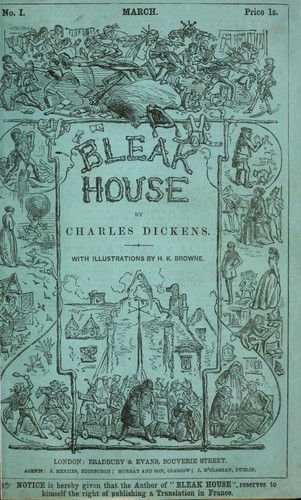
Public domain. Not under copyright: Dickens, Charles (d. 1870). Everyone credited died more than 50 years ago, outside Pakistan's life-plus-50 term, and Project Gutenberg lists the text as public domain. Newer translations or editions can carry separate rights. Source: Project Gutenberg
However, the compact being virtually made, Mr. Guppy proposes to dispatch the trusty Smallweed to ascertain if Mr. Krook is at home, as in that case they may complete the negotiation without delay. Mr. Jobling approving, Smallweed puts himself under the tall hat and conveys it out of the dining-rooms in the Guppy manner. He soon returns with the intelligence that Mr. Krook is at home and that he has seen him through the shop-door, sitting in the back premises, sleeping “like one o’clock.”
“Then I’ll pay,” says Mr. Guppy, “and we’ll go and see him. Small, what will it be?”
Mr. Smallweed, compelling the attendance of the waitress with one hitch of his eyelash, instantly replies as follows: “Four veals and hams is three, and four potatoes is three and four, and one summer cabbage is three and six, and three marrows is four and six, and six breads is five, and three Cheshires is five and three, and four half-pints of half-and-half is six and three, and four small rums is eight and three, and three Pollys is eight and six. Eight and six in half a sovereign, Polly, and eighteenpence out!”
Not at all excited by these stupendous calculations, Smallweed dismisses his friends with a cool nod and remains behind to take a little admiring notice of Polly, as opportunity may serve, and to read the daily papers, which are so very large in proportion to himself, shorn of his hat, that when he holds up the Times to run his eye over the columns, he seems to have retired for the night and to have disappeared under the bedclothes.
Mr. Guppy and Mr. Jobling repair to the rag and bottle shop, where they find Krook still sleeping like one o’clock, that is to say, breathing stertorously with his chin upon his breast and quite insensible to any external sounds or even to gentle shaking. On the table beside him, among the usual lumber, stand an empty gin-bottle and a glass. The unwholesome air is so stained with this liquor that even the green eyes of the cat upon her shelf, as they open and shut and glimmer on the visitors, look drunk.
“Hold up here!” says Mr. Guppy, giving the relaxed figure of the old man another shake. “Mr. Krook! Halloa, sir!”
But it would seem as easy to wake a bundle of old clothes with a spirituous heat smouldering in it. “Did you ever see such a stupor as he falls into, between drink and sleep?” says Mr. Guppy.
“If this is his regular sleep,” returns Jobling, rather alarmed, “it’ll last a long time one of these days, I am thinking.”
“It’s always more like a fit than a nap,” says Mr. Guppy, shaking him again. “Halloa, your lordship! Why, he might be robbed fifty times over! Open your eyes!”
After much ado, he opens them, but without appearing to see his visitors or any other objects. Though he crosses one leg on another, and folds his hands, and several times closes and opens his parched lips, he seems to all intents and purposes as insensible as before.
“He is alive, at any rate,” says Mr. Guppy. “How are you, my Lord Chancellor. I have brought a friend of mine, sir, on a little matter of business.”
The old man still sits, often smacking his dry lips without the least consciousness. After some minutes he makes an attempt to rise. They help him up, and he staggers against the wall and stares at them.
“How do you do, Mr. Krook?” says Mr. Guppy in some discomfiture. “How do you do, sir? You are looking charming, Mr. Krook. I hope you are pretty well?”
The old man, in aiming a purposeless blow at Mr. Guppy, or at nothing, feebly swings himself round and comes with his face against the wall. So he remains for a minute or two, heaped up against it, and then staggers down the shop to the front door. The air, the movement in the court, the lapse of time, or the combination of these things recovers him. He comes back pretty steadily, adjusting his fur cap on his head and looking keenly at them.
“Your servant, gentlemen; I’ve been dozing. Hi! I am hard to wake, odd times.”
“Rather so, indeed, sir,” responds Mr. Guppy.
“What? You’ve been a-trying to do it, have you?” says the suspicious Krook.
“Only a little,” Mr. Guppy explains.
The old man’s eye resting on the empty bottle, he takes it up, examines it, and slowly tilts it upside down.
“I say!” he cries like the hobgoblin in the story. “Somebody’s been making free here!”
“I assure you we found it so,” says Mr. Guppy. “Would you allow me to get it filled for you?”
“Yes, certainly I would!” cries Krook in high glee. “Certainly I would! Don’t mention it! Get it filled next door—Sol’s Arms—the Lord Chancellor’s fourteenpenny. Bless you, they know ME!”
He so presses the empty bottle upon Mr. Guppy that that gentleman, with a nod to his friend, accepts the trust and hurries out and hurries in again with the bottle filled. The old man receives it in his arms like a beloved grandchild and pats it tenderly.
“But, I say,” he whispers, with his eyes screwed up, after tasting it, “this ain’t the Lord Chancellor’s fourteenpenny. This is eighteenpenny!”
“I thought you might like that better,” says Mr. Guppy.
“You’re a nobleman, sir,” returns Krook with another taste, and his hot breath seems to come towards them like a flame. “You’re a baron of the land.”
Taking advantage of this auspicious moment, Mr. Guppy presents his friend under the impromptu name of Mr. Weevle and states the object of their visit. Krook, with his bottle under his arm (he never gets beyond a certain point of either drunkenness or sobriety), takes time to survey his proposed lodger and seems to approve of him. “You’d like to see the room, young man?” he says. “Ah! It’s a good room! Been whitewashed. Been cleaned down with soft soap and soda. Hi! It’s worth twice the rent, letting alone my company when you want it and such a cat to keep the mice away.”
Commending the room after this manner, the old man takes them upstairs, where indeed they do find it cleaner than it used to be and also containing some old articles of furniture which he has dug up from his inexhaustible stores. The terms are easily concluded—for the Lord Chancellor cannot be hard on Mr. Guppy, associated as he is with Kenge and Carboy, Jarndyce and Jarndyce, and other famous claims on his professional consideration—and it is agreed that Mr. Weevle shall take possession on the morrow. Mr. Weevle and Mr. Guppy then repair to Cook’s Court, Cursitor Street, where the personal introduction of the former to Mr. Snagsby is effected and (more important) the vote and interest of Mrs. Snagsby are secured. They then report progress to the eminent Smallweed, waiting at the office in his tall hat for that purpose, and separate, Mr. Guppy explaining that he would terminate his little entertainment by standing treat at the play but that there are chords in the human mind which would render it a hollow mockery.
On the morrow, in the dusk of evening, Mr. Weevle modestly appears at Krook’s, by no means incommoded with luggage, and establishes himself in his new lodging, where the two eyes in the shutters stare at him in his sleep, as if they were full of wonder. On the following day Mr. Weevle, who is a handy good-for-nothing kind of young fellow, borrows a needle and thread of Miss Flite and a hammer of his landlord and goes to work devising apologies for window-curtains, and knocking up apologies for shelves, and hanging up his two teacups, milkpot, and crockery sundries on a pennyworth of little hooks, like a shipwrecked sailor making the best of it.
But what Mr. Weevle prizes most of all his few possessions (next after his light whiskers, for which he has an attachment that only whiskers can awaken in the breast of man) is a choice collection of copper-plate impressions from that truly national work The Divinities of Albion, or Galaxy Gallery of British Beauty, representing ladies of title and fashion in every variety of smirk that art, combined with capital, is capable of producing. With these magnificent portraits, unworthily confined in a band-box during his seclusion among the market-gardens, he decorates his apartment; and as the Galaxy Gallery of British Beauty wears every variety of fancy dress, plays every variety of musical instrument, fondles every variety of dog, ogles every variety of prospect, and is backed up by every variety of flower-pot and balustrade, the result is very imposing.
But fashion is Mr. Weevle’s, as it was Tony Jobling’s, weakness. To borrow yesterday’s paper from the Sol’s Arms of an evening and read about the brilliant and distinguished meteors that are shooting across the fashionable sky in every direction is unspeakable consolation to him. To know what member of what brilliant and distinguished circle accomplished the brilliant and distinguished feat of joining it yesterday or contemplates the no less brilliant and distinguished feat of leaving it to-morrow gives him a thrill of joy. To be informed what the Galaxy Gallery of British Beauty is about, and means to be about, and what Galaxy marriages are on the tapis, and what Galaxy rumours are in circulation, is to become acquainted with the most glorious destinies of mankind. Mr. Weevle reverts from this intelligence to the Galaxy portraits implicated, and seems to know the originals, and to be known of them.
For the rest he is a quiet lodger, full of handy shifts and devices as before mentioned, able to cook and clean for himself as well as to carpenter, and developing social inclinations after the shades of evening have fallen on the court. At those times, when he is not visited by Mr. Guppy or by a small light in his likeness quenched in a dark hat, he comes out of his dull room—where he has inherited the deal wilderness of desk bespattered with a rain of ink—and talks to Krook or is “very free,” as they call it in the court, commendingly, with any one disposed for conversation. Wherefore, Mrs. Piper, who leads the court, is impelled to offer two remarks to Mrs. Perkins: firstly, that if her Johnny was to have whiskers, she could wish ’em to be identically like that young man’s; and secondly, “Mark my words, Mrs. Perkins, ma’am, and don’t you be surprised, Lord bless you, if that young man comes in at last for old Krook’s money!”
Be the first to comment.