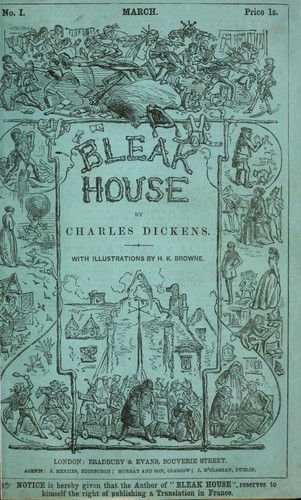
Public domain. Not under copyright: Dickens, Charles (d. 1870). Everyone credited died more than 50 years ago, outside Pakistan's life-plus-50 term, and Project Gutenberg lists the text as public domain. Newer translations or editions can carry separate rights. Source: Project Gutenberg
In deep dejection Mr. Snagsby sits down on his stool, with his back against his desk, protesting, “I never had a secret of my own, sir. I can’t charge my memory with ever having once attempted to deceive my little woman on my own account since she named the day. I wouldn’t have done it, sir. Not to put too fine a point upon it, I couldn’t have done it, I dursn’t have done it. Whereas, and nevertheless, I find myself wrapped round with secrecy and mystery, till my life is a burden to me.”
His visitor professes his regret to hear it and asks him does he remember Jo. Mr. Snagsby answers with a suppressed groan, oh, don’t he!
“You couldn’t name an individual human being—except myself—that my little woman is more set and determined against than Jo,” says Mr. Snagsby.
Allan asks why.
“Why?” repeats Mr. Snagsby, in his desperation clutching at the clump of hair at the back of his bald head. “How should I know why? But you are a single person, sir, and may you long be spared to ask a married person such a question!”
With this beneficent wish, Mr. Snagsby coughs a cough of dismal resignation and submits himself to hear what the visitor has to communicate.
“There again!” says Mr. Snagsby, who, between the earnestness of his feelings and the suppressed tones of his voice is discoloured in the face. “At it again, in a new direction! A certain person charges me, in the solemnest way, not to talk of Jo to any one, even my little woman. Then comes another certain person, in the person of yourself, and charges me, in an equally solemn way, not to mention Jo to that other certain person above all other persons. Why, this is a private asylum! Why, not to put too fine a point upon it, this is Bedlam, sir!” says Mr. Snagsby.
But it is better than he expected after all, being no explosion of the mine below him or deepening of the pit into which he has fallen. And being tender-hearted and affected by the account he hears of Jo’s condition, he readily engages to “look round” as early in the evening as he can manage it quietly. He looks round very quietly when the evening comes, but it may turn out that Mrs. Snagsby is as quiet a manager as he.
Jo is very glad to see his old friend and says, when they are left alone, that he takes it uncommon kind as Mr. Sangsby should come so far out of his way on accounts of sich as him. Mr. Snagsby, touched by the spectacle before him, immediately lays upon the table half a crown, that magic balsam of his for all kinds of wounds.
“And how do you find yourself, my poor lad?” inquires the stationer with his cough of sympathy.
“I am in luck, Mr. Sangsby, I am,” returns Jo, “and don’t want for nothink. I’m more cumfbler nor you can’t think. Mr. Sangsby! I’m wery sorry that I done it, but I didn’t go fur to do it, sir.”
The stationer softly lays down another half-crown and asks him what it is that he is sorry for having done.
“Mr. Sangsby,” says Jo, “I went and giv a illness to the lady as wos and yit as warn’t the t’other lady, and none of ’em never says nothink to me for having done it, on accounts of their being ser good and my having been s’unfortnet. The lady come herself and see me yesday, and she ses, ‘Ah, Jo!’ she ses. ‘We thought we’d lost you, Jo!’ she ses. And she sits down a-smilin so quiet, and don’t pass a word nor yit a look upon me for having done it, she don’t, and I turns agin the wall, I doos, Mr. Sangsby. And Mr. Jarnders, I see him a-forced to turn away his own self. And Mr. Woodcot, he come fur to giv me somethink fur to ease me, wot he’s allus a-doin’ on day and night, and wen he come a-bending over me and a-speakin up so bold, I see his tears a-fallin, Mr. Sangsby.”
The softened stationer deposits another half-crown on the table. Nothing less than a repetition of that infallible remedy will relieve his feelings.
“Wot I was a-thinkin on, Mr. Sangsby,” proceeds Jo, “wos, as you wos able to write wery large, p’raps?”
“Yes, Jo, please God,” returns the stationer.
“Uncommon precious large, p’raps?” says Jo with eagerness.
“Yes, my poor boy.”
Jo laughs with pleasure. “Wot I wos a-thinking on then, Mr. Sangsby, wos, that when I wos moved on as fur as ever I could go and couldn’t be moved no furder, whether you might be so good p’raps as to write out, wery large so that any one could see it anywheres, as that I wos wery truly hearty sorry that I done it and that I never went fur to do it, and that though I didn’t know nothink at all, I knowd as Mr. Woodcot once cried over it and wos allus grieved over it, and that I hoped as he’d be able to forgive me in his mind. If the writin could be made to say it wery large, he might.”
“It shall say it, Jo. Very large.”
Jo laughs again. “Thankee, Mr. Sangsby. It’s wery kind of you, sir, and it makes me more cumfbler nor I was afore.”
The meek little stationer, with a broken and unfinished cough, slips down his fourth half-crown—he has never been so close to a case requiring so many—and is fain to depart. And Jo and he, upon this little earth, shall meet no more. No more.
For the cart so hard to draw is near its journey’s end and drags over stony ground. All round the clock it labours up the broken steps, shattered and worn. Not many times can the sun rise and behold it still upon its weary road.
Phil Squod, with his smoky gunpowder visage, at once acts as nurse and works as armourer at his little table in a corner, often looking round and saying with a nod of his green-baize cap and an encouraging elevation of his one eyebrow, “Hold up, my boy! Hold up!” There, too, is Mr. Jarndyce many a time, and Allan Woodcourt almost always, both thinking, much, how strangely fate has entangled this rough outcast in the web of very different lives. There, too, the trooper is a frequent visitor, filling the doorway with his athletic figure and, from his superfluity of life and strength, seeming to shed down temporary vigour upon Jo, who never fails to speak more robustly in answer to his cheerful words.
Jo is in a sleep or in a stupor to-day, and Allan Woodcourt, newly arrived, stands by him, looking down upon his wasted form. After a while he softly seats himself upon the bedside with his face towards him—just as he sat in the law-writer’s room—and touches his chest and heart. The cart had very nearly given up, but labours on a little more.
The trooper stands in the doorway, still and silent. Phil has stopped in a low clinking noise, with his little hammer in his hand. Mr. Woodcourt looks round with that grave professional interest and attention on his face, and glancing significantly at the trooper, signs to Phil to carry his table out. When the little hammer is next used, there will be a speck of rust upon it.
“Well, Jo! What is the matter? Don’t be frightened.”
“I thought,” says Jo, who has started and is looking round, “I thought I was in Tom-all-Alone’s agin. Ain’t there nobody here but you, Mr. Woodcot?”
“Nobody.”
“And I ain’t took back to Tom-all-Alone’s. Am I, sir?”
“No.” Jo closes his eyes, muttering, “I’m wery thankful.”
After watching him closely a little while, Allan puts his mouth very near his ear and says to him in a low, distinct voice, “Jo! Did you ever know a prayer?”
“Never knowd nothink, sir.”
“Not so much as one short prayer?”
“No, sir. Nothink at all. Mr. Chadbands he wos a-prayin wunst at Mr. Sangsby’s and I heerd him, but he sounded as if he wos a-speakin’ to hisself, and not to me. He prayed a lot, but I couldn’t make out nothink on it. Different times there was other genlmen come down Tom-all-Alone’s a-prayin, but they all mostly sed as the t’other ’wuns prayed wrong, and all mostly sounded to be a-talking to theirselves, or a-passing blame on the t’others, and not a-talkin to us. WE never knowd nothink. I never knowd what it wos all about.”
It takes him a long time to say this, and few but an experienced and attentive listener could hear, or, hearing, understand him. After a short relapse into sleep or stupor, he makes, of a sudden, a strong effort to get out of bed.
“Stay, Jo! What now?”
“It’s time for me to go to that there berryin ground, sir,” he returns with a wild look.
“Lie down, and tell me. What burying ground, Jo?”
“Where they laid him as wos wery good to me, wery good to me indeed, he wos. It’s time fur me to go down to that there berryin ground, sir, and ask to be put along with him. I wants to go there and be berried. He used fur to say to me, ‘I am as poor as you to-day, Jo,’ he ses. I wants to tell him that I am as poor as him now and have come there to be laid along with him.”
“By and by, Jo. By and by.”
“Ah! P’raps they wouldn’t do it if I wos to go myself. But will you promise to have me took there, sir, and laid along with him?”
“I will, indeed.”
“Thankee, sir. Thankee, sir. They’ll have to get the key of the gate afore they can take me in, for it’s allus locked. And there’s a step there, as I used for to clean with my broom. It’s turned wery dark, sir. Is there any light a-comin?”
“It is coming fast, Jo.”
Fast. The cart is shaken all to pieces, and the rugged road is very near its end.
“Jo, my poor fellow!”
“I hear you, sir, in the dark, but I’m a-gropin—a-gropin—let me catch hold of your hand.”
“Jo, can you say what I say?”
“I’ll say anythink as you say, sir, for I knows it’s good.”
“Our Father.”
“Our Father! Yes, that’s wery good, sir.”
“Which art in heaven.”
“Art in heaven—is the light a-comin, sir?”
“It is close at hand. Hallowed be thy name!”
“Hallowed be—thy—”
The light is come upon the dark benighted way. Dead!
Dead, your Majesty. Dead, my lords and gentlemen. Dead, right reverends and wrong reverends of every order. Dead, men and women, born with heavenly compassion in your hearts. And dying thus around us every day.
Be the first to comment.