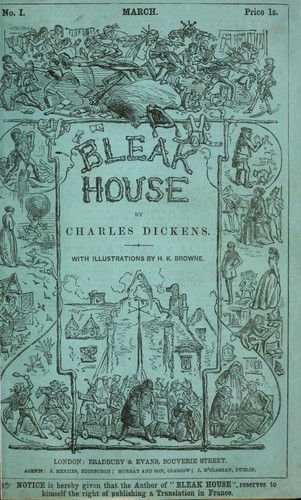
Public domain. Not under copyright: Dickens, Charles (d. 1870). Everyone credited died more than 50 years ago, outside Pakistan's life-plus-50 term, and Project Gutenberg lists the text as public domain. Newer translations or editions can carry separate rights. Source: Project Gutenberg
“I should like to have seen Jenny very much,” said I, “for I am sure she would have told me all she could about this lady, whom I am very anxious indeed—you cannot think how anxious—to overtake. Will Jenny be here soon? Where is she?”
The woman had a great desire to answer, but the man, with another oath, openly kicked at her foot with his heavy boot. He left it to Jenny’s husband to say what he chose, and after a dogged silence the latter turned his shaggy head towards me.
“I’m not partial to gentlefolks coming into my place, as you’ve heerd me say afore now, I think, miss. I let their places be, and it’s curious they can’t let my place be. There’d be a pretty shine made if I was to go a-wisitin THEM, I think. Howsoever, I don’t so much complain of you as of some others, and I’m agreeable to make you a civil answer, though I give notice that I’m not a-going to be drawed like a badger. Will Jenny be here soon? No she won’t. Where is she? She’s gone up to Lunnun.”
“Did she go last night?” I asked.
“Did she go last night? Ah! She went last night,” he answered with a sulky jerk of his head.
“But was she here when the lady came? And what did the lady say to her? And where is the lady gone? I beg and pray you to be so kind as to tell me,” said I, “for I am in great distress to know.”
“If my master would let me speak, and not say a word of harm—” the woman timidly began.
“Your master,” said her husband, muttering an imprecation with slow emphasis, “will break your neck if you meddle with wot don’t concern you.”
After another silence, the husband of the absent woman, turning to me again, answered me with his usual grumbling unwillingness.
“Wos Jenny here when the lady come? Yes, she wos here when the lady come. Wot did the lady say to her? Well, I’ll tell you wot the lady said to her. She said, ‘You remember me as come one time to talk to you about the young lady as had been a-wisiting of you? You remember me as give you somethink handsome for a handkercher wot she had left?’ Ah, she remembered. So we all did. Well, then, wos that young lady up at the house now? No, she warn’t up at the house now. Well, then, lookee here. The lady was upon a journey all alone, strange as we might think it, and could she rest herself where you’re a setten for a hour or so. Yes she could, and so she did. Then she went—it might be at twenty minutes past eleven, and it might be at twenty minutes past twelve; we ain’t got no watches here to know the time by, nor yet clocks. Where did she go? I don’t know where she go’d. She went one way, and Jenny went another; one went right to Lunnun, and t’other went right from it. That’s all about it. Ask this man. He heerd it all, and see it all. He knows.”
The other man repeated, “That’s all about it.”
“Was the lady crying?” I inquired.
“Devil a bit,” returned the first man. “Her shoes was the worse, and her clothes was the worse, but she warn’t—not as I see.”
The woman sat with her arms crossed and her eyes upon the ground. Her husband had turned his seat a little so as to face her and kept his hammer-like hand upon the table as if it were in readiness to execute his threat if she disobeyed him.
“I hope you will not object to my asking your wife,” said I, “how the lady looked.”
“Come, then!” he gruffly cried to her. “You hear what she says. Cut it short and tell her.”
“Bad,” replied the woman. “Pale and exhausted. Very bad.”
“Did she speak much?”
“Not much, but her voice was hoarse.”
She answered, looking all the while at her husband for leave.
“Was she faint?” said I. “Did she eat or drink here?”
“Go on!” said the husband in answer to her look. “Tell her and cut it short.”
“She had a little water, miss, and Jenny fetched her some bread and tea. But she hardly touched it.”
“And when she went from here,” I was proceeding, when Jenny’s husband impatiently took me up.
“When she went from here, she went right away nor’ard by the high road. Ask on the road if you doubt me, and see if it warn’t so. Now, there’s the end. That’s all about it.”
I glanced at my companion, and finding that he had already risen and was ready to depart, thanked them for what they had told me, and took my leave. The woman looked full at Mr. Bucket as he went out, and he looked full at her.
“Now, Miss Summerson,” he said to me as we walked quickly away. “They’ve got her ladyship’s watch among ’em. That’s a positive fact.”
“You saw it?” I exclaimed.
“Just as good as saw it,” he returned. “Else why should he talk about his ‘twenty minutes past’ and about his having no watch to tell the time by? Twenty minutes! He don’t usually cut his time so fine as that. If he comes to half-hours, it’s as much as HE does. Now, you see, either her ladyship gave him that watch or he took it. I think she gave it him. Now, what should she give it him for? What should she give it him for?”
He repeated this question to himself several times as we hurried on, appearing to balance between a variety of answers that arose in his mind.
“If time could be spared,” said Mr. Bucket, “which is the only thing that can’t be spared in this case, I might get it out of that woman; but it’s too doubtful a chance to trust to under present circumstances. They are up to keeping a close eye upon her, and any fool knows that a poor creetur like her, beaten and kicked and scarred and bruised from head to foot, will stand by the husband that ill uses her through thick and thin. There’s something kept back. It’s a pity but what we had seen the other woman.”
I regretted it exceedingly, for she was very grateful, and I felt sure would have resisted no entreaty of mine.
“It’s possible, Miss Summerson,” said Mr. Bucket, pondering on it, “that her ladyship sent her up to London with some word for you, and it’s possible that her husband got the watch to let her go. It don’t come out altogether so plain as to please me, but it’s on the cards. Now, I don’t take kindly to laying out the money of Sir Leicester Dedlock, Baronet, on these roughs, and I don’t see my way to the usefulness of it at present. No! So far our road, Miss Summerson, is for’ard—straight ahead—and keeping everything quiet!”
We called at home once more that I might send a hasty note to my guardian, and then we hurried back to where we had left the carriage. The horses were brought out as soon as we were seen coming, and we were on the road again in a few minutes.
It had set in snowing at daybreak, and it now snowed hard. The air was so thick with the darkness of the day and the density of the fall that we could see but a very little way in any direction. Although it was extremely cold, the snow was but partially frozen, and it churned—with a sound as if it were a beach of small shells—under the hoofs of the horses into mire and water. They sometimes slipped and floundered for a mile together, and we were obliged to come to a standstill to rest them. One horse fell three times in this first stage, and trembled so and was so shaken that the driver had to dismount from his saddle and lead him at last.
I could eat nothing and could not sleep, and I grew so nervous under those delays and the slow pace at which we travelled that I had an unreasonable desire upon me to get out and walk. Yielding to my companion’s better sense, however, I remained where I was. All this time, kept fresh by a certain enjoyment of the work in which he was engaged, he was up and down at every house we came to, addressing people whom he had never beheld before as old acquaintances, running in to warm himself at every fire he saw, talking and drinking and shaking hands at every bar and tap, friendly with every waggoner, wheelwright, blacksmith, and toll-taker, yet never seeming to lose time, and always mounting to the box again with his watchful, steady face and his business-like “Get on, my lad!”
When we were changing horses the next time, he came from the stable-yard, with the wet snow encrusted upon him and dropping off him—plashing and crashing through it to his wet knees as he had been doing frequently since we left Saint Albans—and spoke to me at the carriage side.
“Keep up your spirits. It’s certainly true that she came on here, Miss Summerson. There’s not a doubt of the dress by this time, and the dress has been seen here.”
“Still on foot?” said I.
“Still on foot. I think the gentleman you mentioned must be the point she’s aiming at, and yet I don’t like his living down in her own part of the country neither.”
“I know so little,” said I. “There may be some one else nearer here, of whom I never heard.”
“That’s true. But whatever you do, don’t you fall a-crying, my dear; and don’t you worry yourself no more than you can help. Get on, my lad!”
The sleet fell all that day unceasingly, a thick mist came on early, and it never rose or lightened for a moment. Such roads I had never seen. I sometimes feared we had missed the way and got into the ploughed grounds or the marshes. If I ever thought of the time I had been out, it presented itself as an indefinite period of great duration, and I seemed, in a strange way, never to have been free from the anxiety under which I then laboured.
As we advanced, I began to feel misgivings that my companion lost confidence. He was the same as before with all the roadside people, but he looked graver when he sat by himself on the box. I saw his finger uneasily going across and across his mouth during the whole of one long weary stage. I overheard that he began to ask the drivers of coaches and other vehicles coming towards us what passengers they had seen in other coaches and vehicles that were in advance. Their replies did not encourage him. He always gave me a reassuring beck of his finger and lift of his eyelid as he got upon the box again, but he seemed perplexed now when he said, “Get on, my lad!”
At last, when we were changing, he told me that he had lost the track of the dress so long that he began to be surprised. It was nothing, he said, to lose such a track for one while, and to take it up for another while, and so on; but it had disappeared here in an unaccountable manner, and we had not come upon it since. This corroborated the apprehensions I had formed, when he began to look at direction-posts, and to leave the carriage at cross roads for a quarter of an hour at a time while he explored them. But I was not to be down-hearted, he told me, for it was as likely as not that the next stage might set us right again.
The next stage, however, ended as that one ended; we had no new clue. There was a spacious inn here, solitary, but a comfortable substantial building, and as we drove in under a large gateway before I knew it, where a landlady and her pretty daughters came to the carriage-door, entreating me to alight and refresh myself while the horses were making ready, I thought it would be uncharitable to refuse. They took me upstairs to a warm room and left me there.
Be the first to comment.