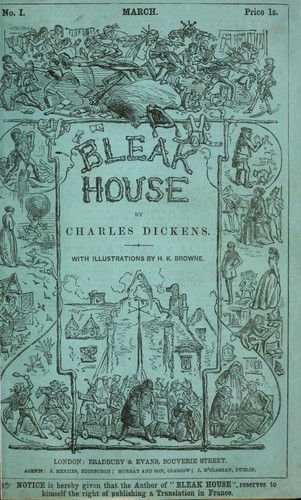
Public domain. Not under copyright: Dickens, Charles (d. 1870). Everyone credited died more than 50 years ago, outside Pakistan's life-plus-50 term, and Project Gutenberg lists the text as public domain. Newer translations or editions can carry separate rights. Source: Project Gutenberg
I went one day to dine with them while I was under this impression. As I turned into Symond’s Inn, I met little Miss Flite coming out. She had been to make a stately call upon the wards in Jarndyce, as she still called them, and had derived the highest gratification from that ceremony. Ada had already told me that she called every Monday at five o’clock, with one little extra white bow in her bonnet, which never appeared there at any other time, and with her largest reticule of documents on her arm.
“My dear!” she began. “So delighted! How do you do! So glad to see you. And you are going to visit our interesting Jarndyce wards? TO be sure! Our beauty is at home, my dear, and will be charmed to see you.”
“Then Richard is not come in yet?” said I. “I am glad of that, for I was afraid of being a little late.”
“No, he is not come in,” returned Miss Flite. “He has had a long day in court. I left him there with Vholes. You don’t like Vholes, I hope? DON’T like Vholes. Dan-gerous man!”
“I am afraid you see Richard oftener than ever now,” said I.
“My dearest,” returned Miss Flite, “daily and hourly. You know what I told you of the attraction on the Chancellor’s table? My dear, next to myself he is the most constant suitor in court. He begins quite to amuse our little party. Ve-ry friendly little party, are we not?”
It was miserable to hear this from her poor mad lips, though it was no surprise.
“In short, my valued friend,” pursued Miss Flite, advancing her lips to my ear with an air of equal patronage and mystery, “I must tell you a secret. I have made him my executor. Nominated, constituted, and appointed him. In my will. Ye-es.”
“Indeed?” said I.
“Ye-es,” repeated Miss Flite in her most genteel accents, “my executor, administrator, and assign. (Our Chancery phrases, my love.) I have reflected that if I should wear out, he will be able to watch that judgment. Being so very regular in his attendance.”
It made me sigh to think of him.
“I did at one time mean,” said Miss Flite, echoing the sigh, “to nominate, constitute, and appoint poor Gridley. Also very regular, my charming girl. I assure you, most exemplary! But he wore out, poor man, so I have appointed his successor. Don’t mention it. This is in confidence.”
She carefully opened her reticule a little way and showed me a folded piece of paper inside as the appointment of which she spoke.
“Another secret, my dear. I have added to my collection of birds.”
“Really, Miss Flite?” said I, knowing how it pleased her to have her confidence received with an appearance of interest.
She nodded several times, and her face became overcast and gloomy. “Two more. I call them the Wards in Jarndyce. They are caged up with all the others. With Hope, Joy, Youth, Peace, Rest, Life, Dust, Ashes, Waste, Want, Ruin, Despair, Madness, Death, Cunning, Folly, Words, Wigs, Rags, Sheepskin, Plunder, Precedent, Jargon, Gammon, and Spinach!”
The poor soul kissed me with the most troubled look I had ever seen in her and went her way. Her manner of running over the names of her birds, as if she were afraid of hearing them even from her own lips, quite chilled me.
This was not a cheering preparation for my visit, and I could have dispensed with the company of Mr. Vholes, when Richard (who arrived within a minute or two after me) brought him to share our dinner. Although it was a very plain one, Ada and Richard were for some minutes both out of the room together helping to get ready what we were to eat and drink. Mr. Vholes took that opportunity of holding a little conversation in a low voice with me. He came to the window where I was sitting and began upon Symond’s Inn.
“A dull place, Miss Summerson, for a life that is not an official one,” said Mr. Vholes, smearing the glass with his black glove to make it clearer for me.
“There is not much to see here,” said I.
“Nor to hear, miss,” returned Mr. Vholes. “A little music does occasionally stray in, but we are not musical in the law and soon eject it. I hope Mr. Jarndyce is as well as his friends could wish him?”
I thanked Mr. Vholes and said he was quite well.
“I have not the pleasure to be admitted among the number of his friends myself,” said Mr. Vholes, “and I am aware that the gentlemen of our profession are sometimes regarded in such quarters with an unfavourable eye. Our plain course, however, under good report and evil report, and all kinds of prejudice (we are the victims of prejudice), is to have everything openly carried on. How do you find Mr. C. looking, Miss Summerson?”
“He looks very ill. Dreadfully anxious.”
“Just so,” said Mr. Vholes.
He stood behind me with his long black figure reaching nearly to the ceiling of those low rooms, feeling the pimples on his face as if they were ornaments and speaking inwardly and evenly as though there were not a human passion or emotion in his nature.
“Mr. Woodcourt is in attendance upon Mr. C., I believe?” he resumed.
“Mr. Woodcourt is his disinterested friend,” I answered.
“But I mean in professional attendance, medical attendance.”
“That can do little for an unhappy mind,” said I.
“Just so,” said Mr. Vholes.
So slow, so eager, so bloodless and gaunt, I felt as if Richard were wasting away beneath the eyes of this adviser and there were something of the vampire in him.
“Miss Summerson,” said Mr. Vholes, very slowly rubbing his gloved hands, as if, to his cold sense of touch, they were much the same in black kid or out of it, “this was an ill-advised marriage of Mr. C.’s.”
I begged he would excuse me from discussing it. They had been engaged when they were both very young, I told him (a little indignantly) and when the prospect before them was much fairer and brighter. When Richard had not yielded himself to the unhappy influence which now darkened his life.
“Just so,” assented Mr. Vholes again. “Still, with a view to everything being openly carried on, I will, with your permission, Miss Summerson, observe to you that I consider this a very ill-advised marriage indeed. I owe the opinion not only to Mr. C.’s connexions, against whom I should naturally wish to protect myself, but also to my own reputation—dear to myself as a professional man aiming to keep respectable; dear to my three girls at home, for whom I am striving to realize some little independence; dear, I will even say, to my aged father, whom it is my privilege to support.”
“It would become a very different marriage, a much happier and better marriage, another marriage altogether, Mr. Vholes,” said I, “if Richard were persuaded to turn his back on the fatal pursuit in which you are engaged with him.”
Mr. Vholes, with a noiseless cough—or rather gasp—into one of his black gloves, inclined his head as if he did not wholly dispute even that.
“Miss Summerson,” he said, “it may be so; and I freely admit that the young lady who has taken Mr. C.’s name upon herself in so ill-advised a manner—you will I am sure not quarrel with me for throwing out that remark again, as a duty I owe to Mr. C.’s connexions—is a highly genteel young lady. Business has prevented me from mixing much with general society in any but a professional character; still I trust I am competent to perceive that she is a highly genteel young lady. As to beauty, I am not a judge of that myself, and I never did give much attention to it from a boy, but I dare say the young lady is equally eligible in that point of view. She is considered so (I have heard) among the clerks in the Inn, and it is a point more in their way than in mine. In reference to Mr. C.’s pursuit of his interests—”
“Oh! His interests, Mr. Vholes!”
“Pardon me,” returned Mr. Vholes, going on in exactly the same inward and dispassionate manner. “Mr. C. takes certain interests under certain wills disputed in the suit. It is a term we use. In reference to Mr. C,’s pursuit of his interests, I mentioned to you, Miss Summerson, the first time I had the pleasure of seeing you, in my desire that everything should be openly carried on—I used those words, for I happened afterwards to note them in my diary, which is producible at any time—I mentioned to you that Mr. C. had laid down the principle of watching his own interests, and that when a client of mine laid down a principle which was not of an immoral (that is to say, unlawful) nature, it devolved upon me to carry it out. I HAVE carried it out; I do carry it out. But I will not smooth things over to any connexion of Mr. C.’s on any account. As open as I was to Mr. Jarndyce, I am to you. I regard it in the light of a professional duty to be so, though it can be charged to no one. I openly say, unpalatable as it may be, that I consider Mr. C.’s affairs in a very bad way, that I consider Mr. C. himself in a very bad way, and that I regard this as an exceedingly ill-advised marriage. Am I here, sir? Yes, I thank you; I am here, Mr. C., and enjoying the pleasure of some agreeable conversation with Miss Summerson, for which I have to thank you very much, sir!”
He broke off thus in answer to Richard, who addressed him as he came into the room. By this time I too well understood Mr. Vholes’s scrupulous way of saving himself and his respectability not to feel that our worst fears did but keep pace with his client’s progress.
We sat down to dinner, and I had an opportunity of observing Richard, anxiously. I was not disturbed by Mr. Vholes (who took off his gloves to dine), though he sat opposite to me at the small table, for I doubt if, looking up at all, he once removed his eyes from his host’s face. I found Richard thin and languid, slovenly in his dress, abstracted in his manner, forcing his spirits now and then, and at other intervals relapsing into a dull thoughtfulness. About his large bright eyes that used to be so merry there was a wanness and a restlessness that changed them altogether. I cannot use the expression that he looked old. There is a ruin of youth which is not like age, and into such a ruin Richard’s youth and youthful beauty had all fallen away.
He ate little and seemed indifferent what it was, showed himself to be much more impatient than he used to be, and was quick even with Ada. I thought at first that his old light-hearted manner was all gone, but it shone out of him sometimes as I had occasionally known little momentary glimpses of my own old face to look out upon me from the glass. His laugh had not quite left him either, but it was like the echo of a joyful sound, and that is always sorrowful.
Yet he was as glad as ever, in his old affectionate way, to have me there, and we talked of the old times pleasantly. These did not appear to be interesting to Mr. Vholes, though he occasionally made a gasp which I believe was his smile. He rose shortly after dinner and said that with the permission of the ladies he would retire to his office.
“Always devoted to business, Vholes!” cried Richard.
Be the first to comment.