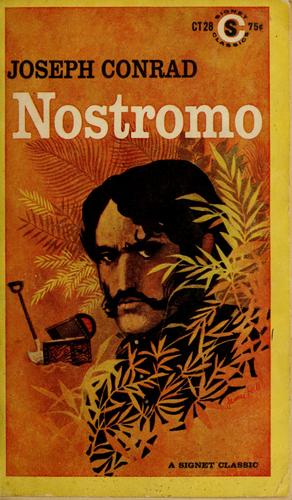
Public domain. Not under copyright: Conrad, Joseph (d. 1924). Everyone credited died more than 50 years ago, outside Pakistan's life-plus-50 term, and Project Gutenberg lists the text as public domain. Newer translations or editions can carry separate rights. Source: Project Gutenberg
Streaming from head to foot, with his hair and whiskers hanging lank and dripping and a lustreless stare fixed upon the bottom boards, the Capataz of the Sulaco Cargadores resembled a drowned corpse come up from the bottom to idle away the sunset hour in a small boat. The excitement of his adventurous ride, the excitement of the return in time, of achievement, of success, all this excitement centred round the associated ideas of the great treasure and of the only other man who knew of its existence, had departed from him. To the very last moment he had been cudgelling his brains as to how he could manage to visit the Great Isabel without loss of time and undetected. For the idea of secrecy had come to be connected with the treasure so closely that even to Barrios himself he had refrained from mentioning the existence of Decoud and of the silver on the island. The letters he carried to the General, however, made brief mention of the loss of the lighter, as having its bearing upon the situation in Sulaco. In the circumstances, the one-eyed tiger-slayer, scenting battle from afar, had not wasted his time in making inquiries from the messenger. In fact, Barrios, talking with Nostromo, assumed that both Don Martin Decoud and the ingots of San Tome were lost together, and Nostromo, not questioned directly, had kept silent, under the influence of some indefinable form of resentment and distrust. Let Don Martin speak of everything with his own lips--was what he told himself mentally.
And now, with the means of gaining the Great Isabel thrown thus in his way at the earliest possible moment, his excitement had departed, as when the soul takes flight leaving the body inert upon an earth it knows no more. Nostromo did not seem to know the gulf. For a long time even his eyelids did not flutter once upon the glazed emptiness of his stare. Then slowly, without a limb having stirred, without a twitch of muscle or quiver of an eyelash, an expression, a living expression came upon the still features, deep thought crept into the empty stare--as if an outcast soul, a quiet, brooding soul, finding that untenanted body in its way, had come in stealthily to take possession.
The Capataz frowned: and in the immense stillness of sea, islands, and coast, of cloud forms on the sky and trails of light upon the water, the knitting of that brow had the emphasis of a powerful gesture. Nothing else budged for a long time; then the Capataz shook his head and again surrendered himself to the universal repose of all visible things. Suddenly he seized the oars, and with one movement made the dinghy spin round, head-on to the Great Isabel. But before he began to pull he bent once more over the brown stain on the gunwale.
“I know that thing,” he muttered to himself, with a sagacious jerk of the head. “That’s blood.”
His stroke was long, vigorous, and steady. Now and then he looked over his shoulder at the Great Isabel, presenting its low cliff to his anxious gaze like an impenetrable face. At last the stem touched the strand. He flung rather than dragged the boat up the little beach. At once, turning his back upon the sunset, he plunged with long strides into the ravine, making the water of the stream spurt and fly upwards at every step, as if spurning its shallow, clear, murmuring spirit with his feet. He wanted to save every moment of daylight.
A mass of earth, grass, and smashed bushes had fallen down very naturally from above upon the cavity under the leaning tree. Decoud had attended to the concealment of the silver as instructed, using the spade with some intelligence. But Nostromo’s half-smile of approval changed into a scornful curl of the lip by the sight of the spade itself flung there in full view, as if in utter carelessness or sudden panic, giving away the whole thing. Ah! They were all alike in their folly, these hombres finos that invented laws and governments and barren tasks for the people.
The Capataz picked up the spade, and with the feel of the handle in his palm the desire of having a look at the horse-hide boxes of treasure came upon him suddenly. In a very few strokes he uncovered the edges and corners of several; then, clearing away more earth, became aware that one of them had been slashed with a knife.
He exclaimed at that discovery in a stifled voice, and dropped on his knees with a look of irrational apprehension over one shoulder, then over the other. The stiff hide had closed, and he hesitated before he pushed his hand through the long slit and felt the ingots inside. There they were. One, two, three. Yes, four gone. Taken away. Four ingots. But who? Decoud? Nobody else. And why? For what purpose? For what cursed fancy? Let him explain. Four ingots carried off in a boat, and--blood!
In the face of the open gulf, the sun, clear, unclouded, unaltered, plunged into the waters in a grave and untroubled mystery of self-immolation consummated far from all mortal eyes, with an infinite majesty of silence and peace. Four ingots short!--and blood!
The Capataz got up slowly.
“He might simply have cut his hand,” he muttered. “But, then----”
He sat down on the soft earth, unresisting, as if he had been chained to the treasure, his drawn-up legs clasped in his hands with an air of hopeless submission, like a slave set on guard. Once only he lifted his head smartly: the rattle of hot musketry fire had reached his ears, like pouring from on high a stream of dry peas upon a drum. After listening for a while, he said, half aloud--
“He will never come back to explain.”
And he lowered his head again.
“Impossible!” he muttered, gloomily.
The sounds of firing died out. The loom of a great conflagration in Sulaco flashed up red above the coast, played on the clouds at the head of the gulf, seemed to touch with a ruddy and sinister reflection the forms of the Three Isabels. He never saw it, though he raised his head.
“But, then, I cannot know,” he pronounced, distinctly, and remained silent and staring for hours.
He could not know. Nobody was to know. As might have been supposed, the end of Don Martin Decoud never became a subject of speculation for any one except Nostromo. Had the truth of the facts been known, there would always have remained the question. Why? Whereas the version of his death at the sinking of the lighter had no uncertainty of motive. The young apostle of Separation had died striving for his idea by an ever-lamented accident. But the truth was that he died from solitude, the enemy known but to few on this earth, and whom only the simplest of us are fit to withstand. The brilliant Costaguanero of the boulevards had died from solitude and want of faith in himself and others.
For some good and valid reasons beyond mere human comprehension, the sea-birds of the gulf shun the Isabels. The rocky head of Azuera is their haunt, whose stony levels and chasms resound with their wild and tumultuous clamour as if they were for ever quarrelling over the legendary treasure.
At the end of his first day on the Great Isabel, Decoud, turning in his lair of coarse grass, under the shade of a tree, said to himself--
“I have not seen as much as one single bird all day.”
And he had not heard a sound, either, all day but that one now of his own muttering voice. It had been a day of absolute silence--the first he had known in his life. And he had not slept a wink. Not for all these wakeful nights and the days of fighting, planning, talking; not for all that last night of danger and hard physical toil upon the gulf, had he been able to close his eyes for a moment. And yet from sunrise to sunset he had been lying prone on the ground, either on his back or on his face.
He stretched himself, and with slow steps descended into the gully to spend the night by the side of the silver. If Nostromo returned--as he might have done at any moment--it was there that he would look first; and night would, of course, be the proper time for an attempt to communicate. He remembered with profound indifference that he had not eaten anything yet since he had been left alone on the island.
He spent the night open-eyed, and when the day broke he ate something with the same indifference. The brilliant “Son Decoud,” the spoiled darling of the family, the lover of Antonia and journalist of Sulaco, was not fit to grapple with himself single-handed. Solitude from mere outward condition of existence becomes very swiftly a state of soul in which the affectations of irony and scepticism have no place. It takes possession of the mind, and drives forth the thought into the exile of utter unbelief. After three days of waiting for the sight of some human face, Decoud caught himself entertaining a doubt of his own individuality. It had merged into the world of cloud and water, of natural forces and forms of nature. In our activity alone do we find the sustaining illusion of an independent existence as against the whole scheme of things of which we form a helpless part. Decoud lost all belief in the reality of his action past and to come. On the fifth day an immense melancholy descended upon him palpably. He resolved not to give himself up to these people in Sulaco, who had beset him, unreal and terrible, like jibbering and obscene spectres. He saw himself struggling feebly in their midst, and Antonia, gigantic and lovely like an allegorical statue, looking on with scornful eyes at his weakness.
Not a living being, not a speck of distant sail, appeared within the range of his vision; and, as if to escape from this solitude, he absorbed himself in his melancholy. The vague consciousness of a misdirected life given up to impulses whose memory left a bitter taste in his mouth was the first moral sentiment of his manhood. But at the same time he felt no remorse. What should he regret? He had recognized no other virtue than intelligence, and had erected passions into duties. Both his intelligence and his passion were swallowed up easily in this great unbroken solitude of waiting without faith. Sleeplessness had robbed his will of all energy, for he had not slept seven hours in the seven days. His sadness was the sadness of a sceptical mind. He beheld the universe as a succession of incomprehensible images. Nostromo was dead. Everything had failed ignominiously. He no longer dared to think of Antonia. She had not survived. But if she survived he could not face her. And all exertion seemed senseless.
Be the first to comment.