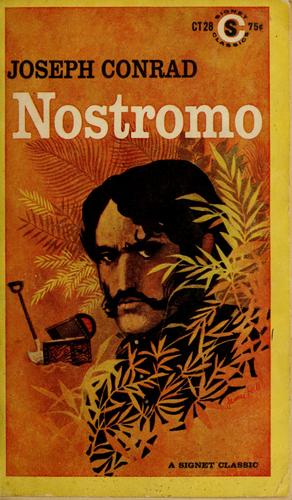
Public domain. Not under copyright: Conrad, Joseph (d. 1924). Everyone credited died more than 50 years ago, outside Pakistan's life-plus-50 term, and Project Gutenberg lists the text as public domain. Newer translations or editions can carry separate rights. Source: Project Gutenberg
Meantime, the steamer had kept on her way towards Sulaco, where only the truth of that matter could be ascertained. Decoud and Nostromo heard the loud churning of her propeller diminish and die out; and then, with no useless words, busied themselves in making for the Isabels. The last shower had brought with it a gentle but steady breeze. The danger was not over yet, and there was no time for talk. The lighter was leaking like a sieve. They splashed in the water at every step. The Capataz put into Decoud’s hands the handle of the pump which was fitted at the side aft, and at once, without question or remark, Decoud began to pump in utter forgetfulness of every desire but that of keeping the treasure afloat. Nostromo hoisted the sail, flew back to the tiller, pulled at the sheet like mad. The short flare of a match (they had been kept dry in a tight tin box, though the man himself was completely wet), disclosed to the toiling Decoud the eagerness of his face, bent low over the box of the compass, and the attentive stare of his eyes. He knew now where he was, and he hoped to run the sinking lighter ashore in the shallow cove where the high, cliff-like end of the Great Isabel is divided in two equal parts by a deep and overgrown ravine.
Decoud pumped without intermission. Nostromo steered without relaxing for a second the intense, peering effort of his stare. Each of them was as if utterly alone with his task. It did not occur to them to speak. There was nothing in common between them but the knowledge that the damaged lighter must be slowly but surely sinking. In that knowledge, which was like the crucial test of their desires, they seemed to have become completely estranged, as if they had discovered in the very shock of the collision that the loss of the lighter would not mean the same thing to them both. This common danger brought their differences in aim, in view, in character, and in position, into absolute prominence in the private vision of each. There was no bond of conviction, of common idea; they were merely two adventurers pursuing each his own adventure, involved in the same imminence of deadly peril. Therefore they had nothing to say to each other. But this peril, this only incontrovertible truth in which they shared, seemed to act as an inspiration to their mental and bodily powers.
There was certainly something almost miraculous in the way the Capataz made the cove with nothing but the shadowy hint of the island’s shape and the vague gleam of a small sandy strip for a guide. Where the ravine opens between the cliffs, and a slender, shallow rivulet meanders out of the bushes to lose itself in the sea, the lighter was run ashore; and the two men, with a taciturn, undaunted energy, began to discharge her precious freight, carrying each ox-hide box up the bed of the rivulet beyond the bushes to a hollow place which the caving in of the soil had made below the roots of a large tree. Its big smooth trunk leaned like a falling column far over the trickle of water running amongst the loose stones.
A couple of years before Nostromo had spent a whole Sunday, all alone, exploring the island. He explained this to Decoud after their task was done, and they sat, weary in every limb, with their legs hanging down the low bank, and their backs against the tree, like a pair of blind men aware of each other and their surroundings by some indefinable sixth sense.
“Yes,” Nostromo repeated, “I never forget a place I have carefully looked at once.” He spoke slowly, almost lazily, as if there had been a whole leisurely life before him, instead of the scanty two hours before daylight. The existence of the treasure, barely concealed in this improbable spot, laid a burden of secrecy upon every contemplated step, upon every intention and plan of future conduct. He felt the partial failure of this desperate affair entrusted to the great reputation he had known how to make for himself. However, it was also a partial success. His vanity was half appeased. His nervous irritation had subsided.
“You never know what may be of use,” he pursued with his usual quietness of tone and manner. “I spent a whole miserable Sunday in exploring this crumb of land.”
“A misanthropic sort of occupation,” muttered Decoud, viciously. “You had no money, I suppose, to gamble with, and to fling about amongst the girls in your usual haunts, Capataz.”
“_E vero!_” exclaimed the Capataz, surprised into the use of his native tongue by so much perspicacity. “I had not! Therefore I did not want to go amongst those beggarly people accustomed to my generosity. It is looked for from the Capataz of the Cargadores, who are the rich men, and, as it were, the Caballeros amongst the common people. I don’t care for cards but as a pastime; and as to those girls that boast of having opened their doors to my knock, you know I wouldn’t look at any one of them twice except for what the people would say. They are queer, the good people of Sulaco, and I have got much useful information simply by listening patiently to the talk of the women that everybody believed I was in love with. Poor Teresa could never understand that. On that particular Sunday, senor, she scolded so that I went out of the house swearing that I would never darken their door again unless to fetch away my hammock and my chest of clothes. Senor, there is nothing more exasperating than to hear a woman you respect rail against your good reputation when you have not a single brass coin in your pocket. I untied one of the small boats and pulled myself out of the harbour with nothing but three cigars in my pocket to help me spend the day on this island. But the water of this rivulet you hear under your feet is cool and sweet and good, senor, both before and after a smoke.” He was silent for a while, then added reflectively, “That was the first Sunday after I brought down the white-whiskered English rico all the way down the mountains from the Paramo on the top of the Entrada Pass--and in the coach, too! No coach had gone up or down that mountain road within the memory of man, senor, till I brought this one down in charge of fifty peons working like one man with ropes, pickaxes, and poles under my direction. That was the rich Englishman who, as people say, pays for the making of this railway. He was very pleased with me. But my wages were not due till the end of the month.”
He slid down the bank suddenly. Decoud heard the splash of his feet in the brook and followed his footsteps down the ravine. His form was lost among the bushes till he had reached the strip of sand under the cliff. As often happens in the gulf when the showers during the first part of the night had been frequent and heavy, the darkness had thinned considerably towards the morning though there were no signs of daylight as yet.
The cargo-lighter, relieved of its precious burden, rocked feebly, half-afloat, with her fore-foot on the sand. A long rope stretched away like a black cotton thread across the strip of white beach to the grapnel Nostromo had carried ashore and hooked to the stem of a tree-like shrub in the very opening of the ravine.
There was nothing for Decoud but to remain on the island. He received from Nostromo’s hands whatever food the foresight of Captain Mitchell had put on board the lighter and deposited it temporarily in the little dinghy which on their arrival they had hauled up out of sight amongst the bushes. It was to be left with him. The island was to be a hiding-place, not a prison; he could pull out to a passing ship. The O.S.N. Company’s mail boats passed close to the islands when going into Sulaco from the north. But the Minerva, carrying off the ex-president, had taken the news up north of the disturbances in Sulaco. It was possible that the next steamer down would get instructions to miss the port altogether since the town, as far as the Minerva’s officers knew, was for the time being in the hands of the rabble. This would mean that there would be no steamer for a month, as far as the mail service went; but Decoud had to take his chance of that. The island was his only shelter from the proscription hanging over his head. The Capataz was, of course, going back. The unloaded lighter leaked much less, and he thought that she would keep afloat as far as the harbour.
He passed to Decoud, standing knee-deep alongside, one of the two spades which belonged to the equipment of each lighter for use when ballasting ships. By working with it carefully as soon as there was daylight enough to see, Decoud could loosen a mass of earth and stones overhanging the cavity in which they had deposited the treasure, so that it would look as if it had fallen naturally. It would cover up not only the cavity, but even all traces of their work, the footsteps, the displaced stones, and even the broken bushes.
“Besides, who would think of looking either for you or the treasure here?” Nostromo continued, as if he could not tear himself away from the spot. “Nobody is ever likely to come here. What could any man want with this piece of earth as long as there is room for his feet on the mainland! The people in this country are not curious. There are even no fishermen here to intrude upon your worship. All the fishing that is done in the gulf goes on near Zapiga, over there. Senor, if you are forced to leave this island before anything can be arranged for you, do not try to make for Zapiga. It is a settlement of thieves and matreros, where they would cut your throat promptly for the sake of your gold watch and chain. And, senor, think twice before confiding in any one whatever; even in the officers of the Company’s steamers, if you ever get on board one. Honesty alone is not enough for security. You must look to discretion and prudence in a man. And always remember, senor, before you open your lips for a confidence, that this treasure may be left safely here for hundreds of years. Time is on its side, senor. And silver is an incorruptible metal that can be trusted to keep its value for ever. . . . An incorruptible metal,” he repeated, as if the idea had given him a profound pleasure.
“As some men are said to be,” Decoud pronounced, inscrutably, while the Capataz, who busied himself in baling out the lighter with a wooden bucket, went on throwing the water over the side with a regular splash. Decoud, incorrigible in his scepticism, reflected, not cynically, but with general satisfaction, that this man was made incorruptible by his enormous vanity, that finest form of egoism which can take on the aspect of every virtue.
Nostromo ceased baling, and, as if struck with a sudden thought, dropped the bucket with a clatter into the lighter.
“Have you any message?” he asked in a lowered voice. “Remember, I shall be asked questions.”
“You must find the hopeful words that ought to be spoken to the people in town. I trust for that your intelligence and your experience, Capataz. You understand?”
Be the first to comment.