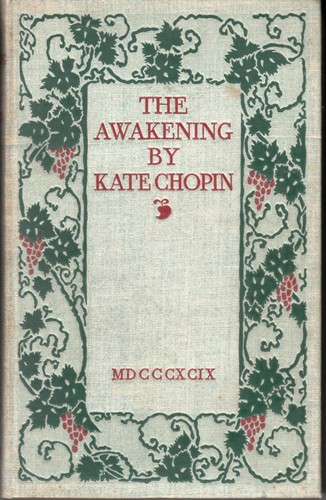
Public domain. Not under copyright: Chopin, Kate (d. 1904). Everyone credited died more than 50 years ago, outside Pakistan's life-plus-50 term, and Project Gutenberg lists the text as public domain. Newer translations or editions can carry separate rights. Source: Project Gutenberg
She wanted something to happen—something, anything; she did not know what. She regretted that she had not made Arobin stay a half hour to talk over the horses with her. She counted the money she had won. But there was nothing else to do, so she went to bed, and tossed there for hours in a sort of monotonous agitation.
In the middle of the night she remembered that she had forgotten to write her regular letter to her husband; and she decided to do so next day and tell him about her afternoon at the Jockey Club. She lay wide awake composing a letter which was nothing like the one which she wrote next day. When the maid awoke her in the morning Edna was dreaming of Mr. Highcamp playing the piano at the entrance of a music store on Canal Street, while his wife was saying to Alcée Arobin, as they boarded an Esplanade Street car:
“What a pity that so much talent has been neglected! but I must go.”
When, a few days later, Alcée Arobin again called for Edna in his drag, Mrs. Highcamp was not with him. He said they would pick her up. But as that lady had not been apprised of his intention of picking her up, she was not at home. The daughter was just leaving the house to attend the meeting of a branch Folk Lore Society, and regretted that she could not accompany them. Arobin appeared nonplused, and asked Edna if there were any one else she cared to ask.
She did not deem it worth while to go in search of any of the fashionable acquaintances from whom she had withdrawn herself. She thought of Madame Ratignolle, but knew that her fair friend did not leave the house, except to take a languid walk around the block with her husband after nightfall. Mademoiselle Reisz would have laughed at such a request from Edna. Madame Lebrun might have enjoyed the outing, but for some reason Edna did not want her. So they went alone, she and Arobin.
The afternoon was intensely interesting to her. The excitement came back upon her like a remittent fever. Her talk grew familiar and confidential. It was no labor to become intimate with Arobin. His manner invited easy confidence. The preliminary stage of becoming acquainted was one which he always endeavored to ignore when a pretty and engaging woman was concerned.
He stayed and dined with Edna. He stayed and sat beside the wood fire. They laughed and talked; and before it was time to go he was telling her how different life might have been if he had known her years before. With ingenuous frankness he spoke of what a wicked, ill-disciplined boy he had been, and impulsively drew up his cuff to exhibit upon his wrist the scar from a saber cut which he had received in a duel outside of Paris when he was nineteen. She touched his hand as she scanned the red cicatrice on the inside of his white wrist. A quick impulse that was somewhat spasmodic impelled her fingers to close in a sort of clutch upon his hand. He felt the pressure of her pointed nails in the flesh of his palm.
She arose hastily and walked toward the mantel.
“The sight of a wound or scar always agitates and sickens me,” she said. “I shouldn’t have looked at it.”
“I beg your pardon,” he entreated, following her; “it never occurred to me that it might be repulsive.”
He stood close to her, and the effrontery in his eyes repelled the old, vanishing self in her, yet drew all her awakening sensuousness. He saw enough in her face to impel him to take her hand and hold it while he said his lingering good night.
“Will you go to the races again?” he asked.
“No,” she said. “I’ve had enough of the races. I don’t want to lose all the money I’ve won, and I’ve got to work when the weather is bright, instead of—”
“Yes; work; to be sure. You promised to show me your work. What morning may I come up to your atelier? To-morrow?”
“No!”
“Day after?”
“No, no.”
“Oh, please don’t refuse me! I know something of such things. I might help you with a stray suggestion or two.”
“No. Good night. Why don’t you go after you have said good night? I don’t like you,” she went on in a high, excited pitch, attempting to draw away her hand. She felt that her words lacked dignity and sincerity, and she knew that he felt it.
“I’m sorry you don’t like me. I’m sorry I offended you. How have I offended you? What have I done? Can’t you forgive me?” And he bent and pressed his lips upon her hand as if he wished never more to withdraw them.
“Mr. Arobin,” she complained, “I’m greatly upset by the excitement of the afternoon; I’m not myself. My manner must have misled you in some way. I wish you to go, please.” She spoke in a monotonous, dull tone. He took his hat from the table, and stood with eyes turned from her, looking into the dying fire. For a moment or two he kept an impressive silence.
“Your manner has not misled me, Mrs. Pontellier,” he said finally. “My own emotions have done that. I couldn’t help it. When I’m near you, how could I help it? Don’t think anything of it, don’t bother, please. You see, I go when you command me. If you wish me to stay away, I shall do so. If you let me come back, I—oh! you will let me come back?”
He cast one appealing glance at her, to which she made no response. Alcée Arobin’s manner was so genuine that it often deceived even himself.
Edna did not care or think whether it were genuine or not. When she was alone she looked mechanically at the back of her hand which he had kissed so warmly. Then she leaned her head down on the mantelpiece. She felt somewhat like a woman who in a moment of passion is betrayed into an act of infidelity, and realizes the significance of the act without being wholly awakened from its glamour. The thought was passing vaguely through her mind, “What would he think?”
She did not mean her husband; she was thinking of Robert Lebrun. Her husband seemed to her now like a person whom she had married without love as an excuse.
She lit a candle and went up to her room. Alcée Arobin was absolutely nothing to her. Yet his presence, his manners, the warmth of his glances, and above all the touch of his lips upon her hand had acted like a narcotic upon her.
She slept a languorous sleep, interwoven with vanishing dreams.
XXVI
Alcée Arobin wrote Edna an elaborate note of apology, palpitant with sincerity. It embarrassed her; for in a cooler, quieter moment it appeared to her absurd that she should have taken his action so seriously, so dramatically. She felt sure that the significance of the whole occurrence had lain in her own self-consciousness. If she ignored his note it would give undue importance to a trivial affair. If she replied to it in a serious spirit it would still leave in his mind the impression that she had in a susceptible moment yielded to his influence. After all, it was no great matter to have one’s hand kissed. She was provoked at his having written the apology. She answered in as light and bantering a spirit as she fancied it deserved, and said she would be glad to have him look in upon her at work whenever he felt the inclination and his business gave him the opportunity.
He responded at once by presenting himself at her home with all his disarming naïveté. And then there was scarcely a day which followed that she did not see him or was not reminded of him. He was prolific in pretexts. His attitude became one of good-humored subservience and tacit adoration. He was ready at all times to submit to her moods, which were as often kind as they were cold. She grew accustomed to him. They became intimate and friendly by imperceptible degrees, and then by leaps. He sometimes talked in a way that astonished her at first and brought the crimson into her face; in a way that pleased her at last, appealing to the animalism that stirred impatiently within her.
There was nothing which so quieted the turmoil of Edna’s senses as a visit to Mademoiselle Reisz. It was then, in the presence of that personality which was offensive to her, that the woman, by her divine art, seemed to reach Edna’s spirit and set it free.
It was misty, with heavy, lowering atmosphere, one afternoon, when Edna climbed the stairs to the pianist’s apartments under the roof. Her clothes were dripping with moisture. She felt chilled and pinched as she entered the room. Mademoiselle was poking at a rusty stove that smoked a little and warmed the room indifferently. She was endeavoring to heat a pot of chocolate on the stove. The room looked cheerless and dingy to Edna as she entered. A bust of Beethoven, covered with a hood of dust, scowled at her from the mantelpiece.
“Ah! here comes the sunlight!” exclaimed Mademoiselle, rising from her knees before the stove. “Now it will be warm and bright enough; I can let the fire alone.”
She closed the stove door with a bang, and approaching, assisted in removing Edna’s dripping mackintosh.
“You are cold; you look miserable. The chocolate will soon be hot. But would you rather have a taste of brandy? I have scarcely touched the bottle which you brought me for my cold.” A piece of red flannel was wrapped around Mademoiselle’s throat; a stiff neck compelled her to hold her head on one side.
“I will take some brandy,” said Edna, shivering as she removed her gloves and overshoes. She drank the liquor from the glass as a man would have done. Then flinging herself upon the uncomfortable sofa she said, “Mademoiselle, I am going to move away from my house on Esplanade Street.”
“Ah!” ejaculated the musician, neither surprised nor especially interested. Nothing ever seemed to astonish her very much. She was endeavoring to adjust the bunch of violets which had become loose from its fastening in her hair. Edna drew her down upon the sofa, and taking a pin from her own hair, secured the shabby artificial flowers in their accustomed place.
“Aren’t you astonished?”
“Passably. Where are you going? to New York? to Iberville? to your father in Mississippi? where?”
“Just two steps away,” laughed Edna, “in a little four-room house around the corner. It looks so cozy, so inviting and restful, whenever I pass by; and it’s for rent. I’m tired looking after that big house. It never seemed like mine, anyway—like home. It’s too much trouble. I have to keep too many servants. I am tired bothering with them.”
“That is not your true reason, _ma belle_. There is no use in telling me lies. I don’t know your reason, but you have not told me the truth.” Edna did not protest or endeavor to justify herself.
“The house, the money that provides for it, are not mine. Isn’t that enough reason?”
“They are your husband’s,” returned Mademoiselle, with a shrug and a malicious elevation of the eyebrows.
Be the first to comment.